


Assam Rolls Out Early Flood Preparedness Measures After Last Year’s Devastation.
With the monsoon season approaching in the coming months, Assam’s early flood preparedness initiative reflects a shift toward proactive governance. Embankment Repairs, Mock Drills and Relief Stockpiling Begin Across Vulnerable Districts.

Guwahati, February 27, 2026:
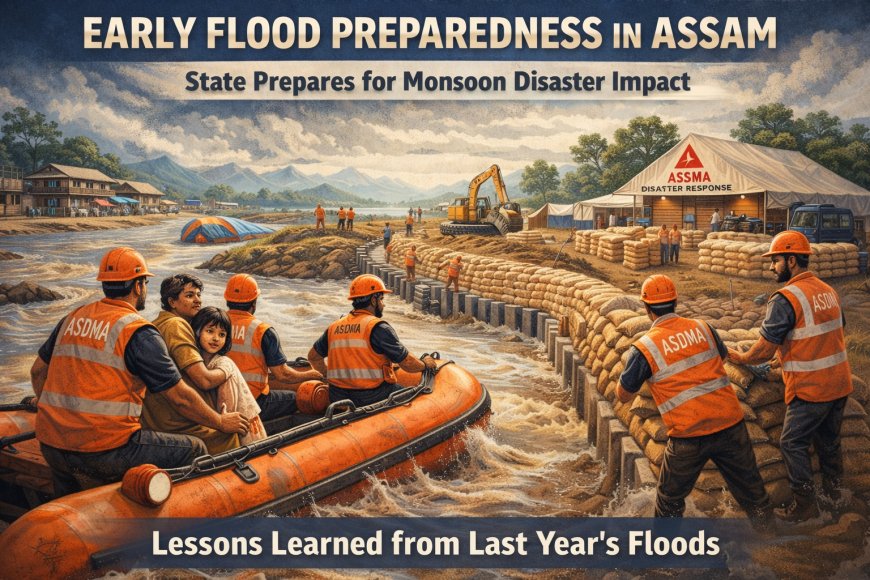
In a proactive move ahead of the monsoon season, the Assam State Disaster Management Authority (ASDMA) has initiated early flood preparedness measures across vulnerable riverine districts of Assam. Authorities confirmed that embankment repairs, mock drills, evacuation planning, and relief stockpiling have already begun, nearly six weeks earlier than in previous years.
The decision comes in the wake of last year’s devastating floods that displaced thousands, damaged infrastructure, and severely impacted agriculture across multiple districts.
Early Start to Pre-Monsoon Planning
Officials said district administrations have been instructed to conduct vulnerability assessments and update contingency plans well before the onset of heavy rains. Teams from the Water Resources Department are currently inspecting embankments along major river systems, including the Brahmaputra and Barak.
High-risk stretches identified through previous breach data are being reinforced with geo-bags and additional soil compaction measures. Emergency repair teams have also been stationed in erosion-prone zones to respond quickly in case of sudden breaches.
“We are focusing on prevention and preparedness rather than post-disaster response,” an ASDMA official said.
Relief Supplies Pre-Positioned
To reduce response time during emergencies, relief materials are being pre-positioned in strategic warehouses across Upper and Lower Assam. These include:
Dry rations such as rice and pulses
Drinking water units and purification tablets
Tarpaulins and temporary shelter materials
Essential medicines and medical kits
Baby food and sanitary supplies
Officials said coordination with the State Disaster Response Force (SDRF) and National Disaster Response Force (NDRF) has also been strengthened to ensure rapid deployment of rescue teams and boats.
Focus on Vulnerable Districts
Riverine districts such as Dhemaji, Lakhimpur, Dibrugarh, Barpeta, and Morigaon remain under close monitoring due to their recurring flood history. In Barak Valley, Cachar and Karimganj are being closely watched as well.
Water level monitoring stations have been activated to provide real-time data, and early warning systems are being updated to ensure timely SMS alerts reach residents in low-lying areas.
The state capital, Guwahati, which often experiences urban flooding due to drainage congestion and hill runoff, is also undergoing intensified desiltation drives and pump maintenance.
Learning from 2025 Floods
Last year’s floods exposed weaknesses in embankment durability, emergency logistics, and inter-agency coordination. Large tracts of agricultural land remained submerged for weeks, while riverbank erosion displaced several families.
Officials acknowledged that changing rainfall patterns and sediment buildup in riverbeds are increasing flood vulnerability. Experts have pointed to climate variability and upstream rainfall in the eastern Himalayas as contributing factors.
This year’s preparedness plan, authorities say, integrates lessons learned from those experiences.
Technology Integration
ASDMA has incorporated improved forecasting tools and satellite mapping to identify high-risk flood zones. GIS-based monitoring systems are being used to track river behavior and forecast potential overflow points.
Drone surveillance is also being deployed in certain districts to inspect embankments and assess erosion-prone stretches.
Officials said real-time monitoring would allow quicker evacuation decisions if water levels rise rapidly.
Community Participation Emphasized
Authorities are also focusing on community-level preparedness. Village Disaster Management Committees have been activated to:
Identify elderly, disabled, and vulnerable residents
Conduct awareness meetings
Coordinate evacuation plans
Maintain community shelters
Local volunteers are being trained in basic rescue and first-aid operations to reduce response delays during emergencies.
Agriculture and Livelihood Protection
Floods remain a major threat to Assam’s agriculture-dependent population. The Agriculture Department has advised farmers to adopt short-duration crop varieties and diversify cultivation patterns to reduce risk.
Livestock vaccination drives are underway in vulnerable districts to prevent post-flood disease outbreaks.
Tea gardens and small-scale industries, which often suffer during prolonged inundation, have also been asked to prepare contingency plans.
Urban Flood Mitigation in Guwahati
Rapid urban expansion has worsened waterlogging issues in Guwahati. Civic authorities have begun clearing clogged drains and restoring natural water channels.
Encroachment removal from certain wetlands is being discussed as part of long-term mitigation planning. Experts stress that wetland preservation plays a crucial role in absorbing excess rainwater.
Health and Emergency Response Readiness
The Health Department has been directed to prepare for waterborne diseases such as diarrhea and cholera, which typically rise during floods.
Mobile medical units will be kept on standby, and primary health centers in flood-prone districts have been stocked with essential medicines.
Broader Economic Stakes
Flooding in Assam disrupts key sectors including tea, oil and gas, agriculture, and transportation. National highways and railway lines are often affected, impacting trade and supply chains.
By initiating preparedness measures early, the government aims to reduce economic losses and accelerate post-flood recovery.
Long-Term Challenges Remain
While early preparedness marks a positive shift, experts argue that structural challenges persist. These include:
Sediment accumulation in riverbeds
Recurring riverbank erosion
Settlement in highly vulnerable zones
Wetland encroachment
Integrated river basin management and long-term climate adaptation strategies, analysts say, are essential for sustainable flood mitigation.
Looking Ahead
With the monsoon season approaching in the coming months, Assam’s early flood preparedness initiative reflects a shift toward proactive governance.
Officials say coordination across departments, technological integration, and community awareness will be key to minimizing damage in 2026.
For a state where floods are an annual reality, early planning may prove crucial in safeguarding lives, livelihoods, and infrastructure.