


Six-Planet Alignment Dazzles the World, Ignites Global Skywatching Frenzy.
A rare and breathtaking six-planet alignment illuminated skies across continents on Saturday evening, drawing millions outdoors to witness one of the most anticipated celestial events of the year. The planetary parade featured Mercury, Venus, Mars, Jupiter, Saturn, and Uranus, aligned along the ecliptic in a rare visual formation visible shortly after sunset. From Asia to Europe and the Americas, astronomers and amateur stargazers reported clear sightings of five of the six planets with the naked eye, while Uranus required binoculars or a small telescope. Social media platforms were quickly flooded with dramatic images of the glowing arc of planets stretching across twilight skies, turning February 28 into a global celebration of astronomy.

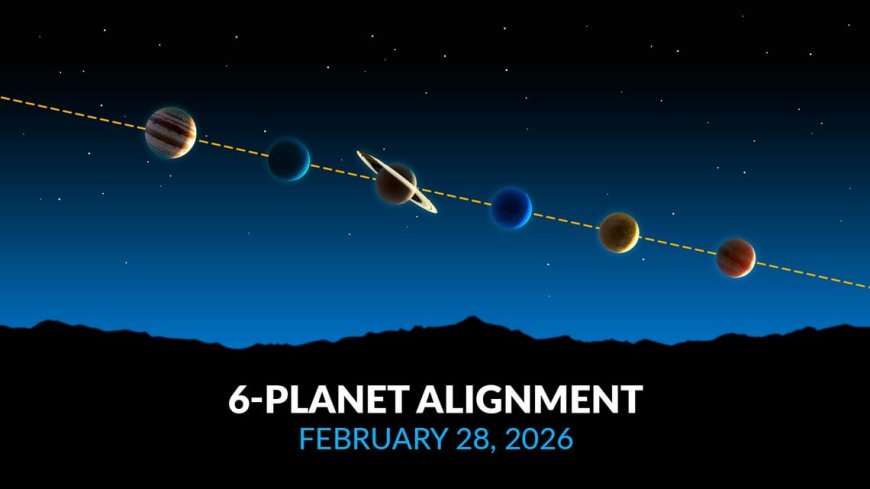
A Rare Planetary Parade
While planetary alignments are not unheard of, six planets appearing clustered within a tight section of the sky is an uncommon event. Because all major planets orbit the Sun within roughly the same flat plane, they occasionally appear to gather along a shared line from Earth’s perspective. However, the orbital periods of these worlds vary dramatically, making synchronized visibility relatively rare.
Mercury, the innermost planet, completes its orbit in just 88 days, while Uranus, located far beyond Saturn, takes 84 years to circle the Sun. For these vastly different orbital cycles to create a simultaneous visual alignment requires precise positioning — something astronomers had predicted years in advance.
The event reached peak visibility within an hour after sunset across much of Asia and Europe, while observers in North and South America enjoyed pre-dawn viewing opportunities.
Best Views from High and Dark Locations
Regions with minimal light pollution and clear western horizons offered the most spectacular views. Elevated areas, rural landscapes, and coastal regions provided optimal vantage points for spotting the planetary lineup.
In many parts of India — particularly hill regions and remote districts — observers reported crisp views of Jupiter shining brightly in the southwest, Venus glowing intensely near the horizon, and Mars appearing as a faint reddish point. Saturn followed closely behind, while Mercury briefly emerged in the fading twilight. Uranus, though dim, was identifiable through optical aids.
Astronomy clubs and science centers across multiple countries organized public viewing sessions, offering telescopic glimpses of Jupiter’s cloud bands and Saturn’s iconic rings. For many first-time viewers, it was a rare opportunity to see multiple worlds in a single sweep of the sky.
Science Behind the Spectacle
Despite the dramatic appearance, experts clarify that the planets were not physically close together in space. In reality, they remained separated by millions — and in some cases billions — of kilometers. The alignment was purely a matter of perspective from Earth.
Astronomers refer to such events as “planetary parades,” which occur when several planets share similar celestial longitudes. Because the Solar System formed from a rotating disk of gas and dust, its planets orbit within nearly the same plane, making alignments possible.
Importantly, scientists emphasized that such alignments have no significant gravitational impact on Earth. The Moon exerts far stronger tidal forces than all the aligned planets combined, dispelling online myths that suggested potential natural disruptions.
Public Excitement and Educational Value
The alignment quickly became one of the most talked-about science events of early 2026. Hashtags related to the phenomenon trended worldwide, with astrophotographers sharing long-exposure images capturing multiple planets glowing in a single frame.
Educators seized the moment to engage students in discussions about orbital mechanics, heliocentric theory, and the scale of the Solar System. Planetariums reported increased attendance, and telescope retailers noted a spike in inquiries in the days leading up to the event.
For many, the alignment served as a reminder of the predictable yet awe-inspiring rhythm of celestial motion — a cosmic dance unfolding above everyday life.
Cultural and Historical Fascination
Planetary alignments have fascinated civilizations for thousands of years. Ancient astronomers meticulously tracked planetary movements, often assigning symbolic meanings to unusual sky patterns. While modern science dismisses astrological interpretations, the cultural resonance of such events remains powerful.
Unlike past eras when alignments sometimes sparked anxiety or superstition, the 2026 event was largely celebrated as a moment of scientific wonder and global unity.
How Rare Is It?
Alignments involving three or four planets occur relatively frequently, sometimes every few years. However, six-planet configurations visible within a compact region of the sky are far less common and depend on favorable viewing conditions.
Astronomers estimate that while multi-planet alignments happen periodically, a similar six-planet arrangement with comparable brightness and accessibility may not occur in the exact same configuration for several years.
Future alignments may include more planets numerically, but not all will be easily visible to the naked eye due to position, brightness, or proximity to the Sun.

A Moment of Shared Perspective
Beyond its scientific intrigue, the February 28 planetary parade offered something intangible — perspective. In an era often dominated by headlines of political tension, economic uncertainty, and climate concerns, millions paused to look skyward.
The silent gathering of distant worlds reminded observers of Earth’s place in a vast cosmic system governed by precise physical laws. The alignment required no ticket, no border, and no special invitation — only a clear sky and curiosity.
As the planets gradually drift apart in the coming weeks, the memory of the alignment will linger in photographs, classroom lessons, and personal reflections. For those who witnessed it, February 28, 2026, will remain a date when the universe briefly staged a performance visible to all.
In the end, the six-planet alignment did not alter the course of history — but it offered a rare and powerful reminder that even amid global complexity, the cosmos continues its steady, magnificent choreography above us.